
A transdiagnostic approach
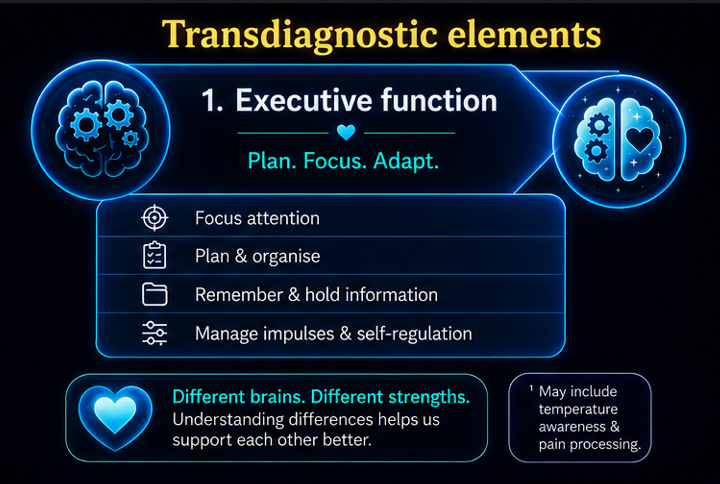
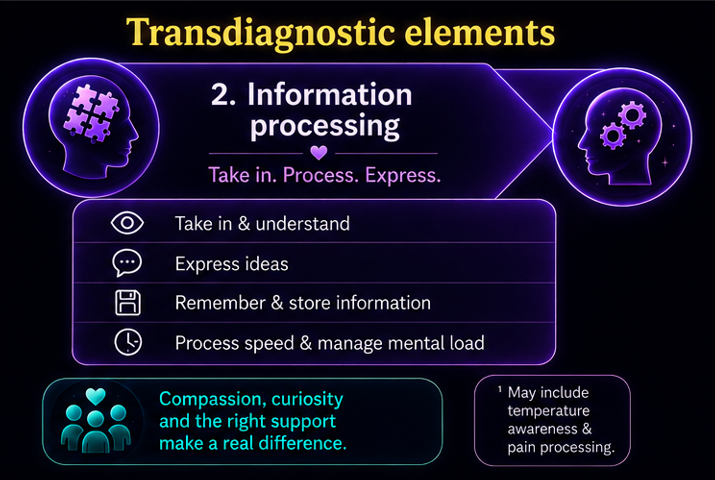
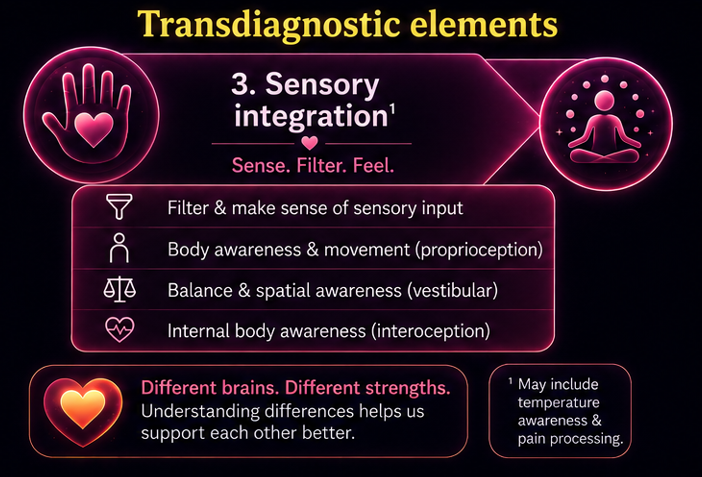
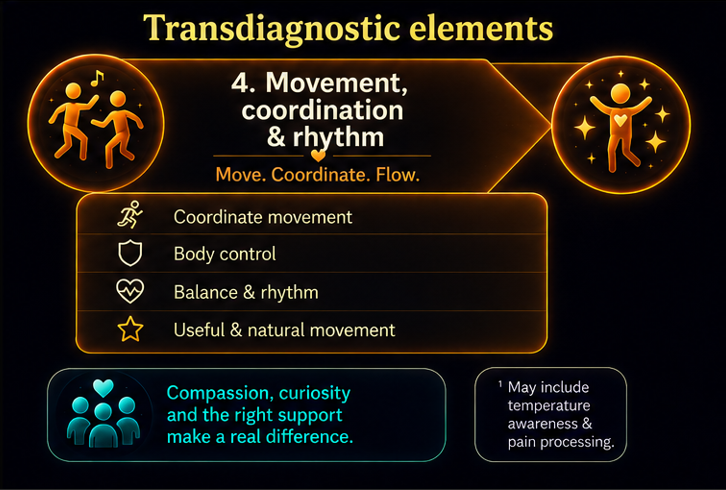
Although diagnostic categories can be clinically useful, neurodevelopmental experiences do not always fit neatly within diagnostic boundaries. Increasingly, transdiagnostic approaches recognise substantial overlap across neurodevelopmental conditions and emphasise shared dimensions of functioning rather than discrete diagnoses (Michelini et al., 2024). Common transdiagnostic domains include executive functioning, information processing, sensory processing and integration, and movement and motor coordination, all of which may influence learning, communication, emotional regulation, and everyday functioning (Blank et al., 2012; Dijkhuis et al., 2019; Passarello et al., 2022; Pedro et al., 2019; Sadozai et al., 2024).
From this perspective, neurodevelopmental differences can be understood as part of natural human neurocognitive diversity. Whilst diagnostic labels may facilitate access to support and accommodations, they do not fully capture the complexity of lived experience. Consequently, understanding an individual's strengths, challenges, context, and personal meaning-making may be as important as diagnosis when informing psychological support (Kapp, 2013, 2018; Robinson, 2025)
These transdiagnostic differences may influence participation across education, employment, healthcare, relationships, and quality of life. However, difficulties often arise through an interaction between individual characteristics and environments that are not designed to accommodate diverse ways of thinking, learning, communicating, and processing information. This perspective highlights the importance of accessible environments, appropriate adjustments, and person-centred support, while helping to explain the elevated rates of co-occurring mental health challenges reported across neurodivergent populations (Baxter et al., 2015; Lee et al., 2019; Schiffman et al., 2015).
For information on guidelines see BPS: Considering the relational: A handbook for working therapeutically with neurodivergent people
References
Blank, R., Smits-Engelsman, B., Polatajko, H., Wilson, P., & European Academy for Childhood Disability. (2012). European Academy for Childhood Disability (EACD): Recommendations on the definition, diagnosis and intervention of developmental coordination disorder (long version). Developmental Medicine & Child Neurology, 54(1), 54–93. https://doi.org/10.1111/j.1469-8749.2011.04171.x
Baxter, A. J., Brugha, T. S., Erskine, H. E., Scheurer, R. W., Vos, T., & Scott, J. G. (2015). The epidemiology and global burden of autism spectrum disorders. Psychological Medicine, 45(3), 601–613. https://doi.org/10.1017/S003329171400172X
Botha, M., Chapman, R., Giwa Onaiwu, M., Kapp, S. K., Stannard Ashley, A., & Walker, N. (2024). The neurodiversity concept was developed collectively: An overdue correction on the origins of neurodiversity theory. Autism, 28(6), 1591–1594. https://doi.org/10.1177/13623613241237871
Chapman, R., & Botha, M. (2023). Neurodivergence-informed therapy. Developmental Medicine & Child Neurology, 65(3), 310–317. https://doi.org/10.1111/dmcn.15384
Coleman, J., & Melia, Y. (2023). Me, My Tics and I: An exploration of self-identity and its implications for psychological wellbeing in young women with Tourette syndrome. Journal of Developmental and Physical Disabilities. Advance online publication. https://doi.org/10.1007/s10882-023-09911-x
Dhar, M., Been, P. H., Minderaa, R. B., & Althaus, M. (2010). Information processing differences and similarities in adults with dyslexia and adults with attention-deficit/hyperactivity disorder during a continuous performance test: A study of cortical potentials. Neuropsychologia, 48(10), 3045–3056. https://doi.org/10.1016/j.neuropsychologia.2010.06.014
Dijkhuis, R., Gurbuz, E., Ziermans, T., Staal, W., & Swaab, H. (2019). Social attention and emotional responsiveness in young adults with autism. Frontiers in Psychiatry, 10, 426. https://doi.org/10.3389/fpsyt.2019.00426
Forde, J. J., & Smyth, S. (2022). Avoidance behavior in adults with developmental coordination disorder is related to quality of life. Journal of Developmental and Physical Disabilities, 34(4), 571–589. https://doi.org/10.1007/s10882-021-09815-8
Michelini, G., Carlisi, C. O., Eaton, N. R., Elison, J. T., Haltigan, J. D., Kotov, R. F., Krueger, R. F., Latzman, R. D., Li, J. J., Levin-Aspenson, H. F., Salum, G. A., South, S. C., Stanton, K., Waldman, I. D., & Wilson, S. (2024). Where do neurodevelopmental conditions fit in transdiagnostic psychiatric frameworks? Incorporating a new neurodevelopmental spectrum. World Psychiatry, 23(3), 333–357. https://doi.org/10.1002/wps.21225
Passarello, N., Tarantino, V., Chirico, A., Menghini, D., Costanzo, F., Sorrentino, P., Fucà, E., Gigliotta, O., Alivernini, F., Oliveri, M., Lucidi, F., Vicari, S., Mandolesi, L., & Turriziani, P. (2022). Sensory Processing Disorders in Children and Adolescents: Taking Stock of Assessment and Novel Therapeutic Tools. Brain Sciences, 12(11), 1478. https://doi.org/10.3390/brainsci12111478
Pedro, A., Goldschmidt, T., & Daniels, L. (2019). Parent-carer awareness and understanding of dyspraxia: Implications for child development support practices. Journal of Psychology in Africa, 29(1), 87–91. https://doi.org/10.1080/14330237.2019.1568092
Sadozai, A. K., Sun, C., Demetriou, E. A., Lampit, A., Munro, M., Perry, N., Boulton, K. A., & Guastella, A. J. (2024). Executive function in children with neurodevelopmental conditions: A systematic review and meta-analysis. Nature Human Behaviour, 8(12), 2357–2366. https://doi.org/10.1038/s41562-024-02000-9