
Dyslexia, Dyscalculia & Dysgraphia
Understanding related specific learning differences
What is Dyslexia?
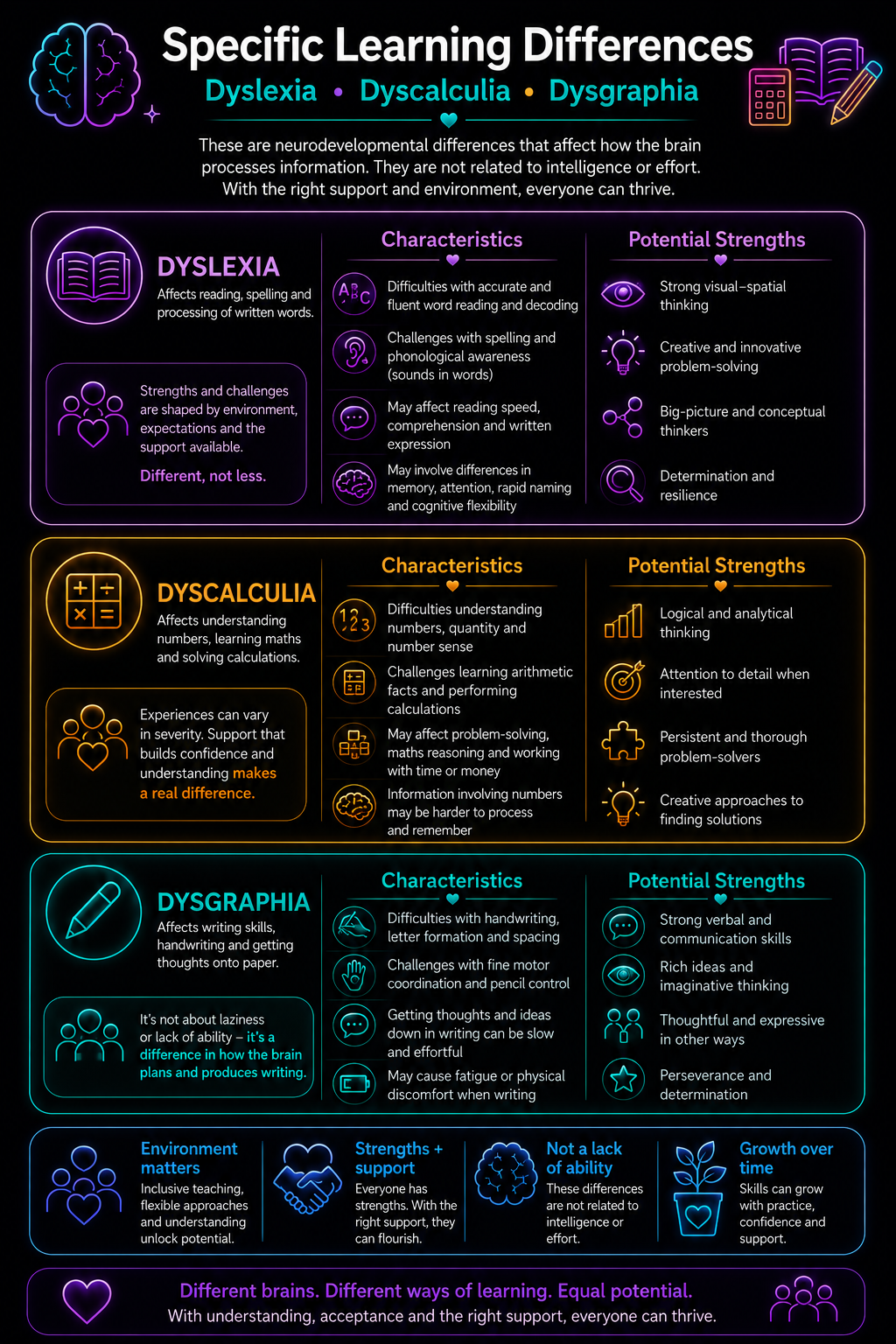
Dyslexia is a neurodevelopmental difference primarily affecting literacy acquisition, including word recognition, decoding, and spelling (British Dyslexia Association, 2024). It is estimated to affect approximately 10% of the population, with around 4% experiencing dyslexia to a significant degree (Rose, 2009).
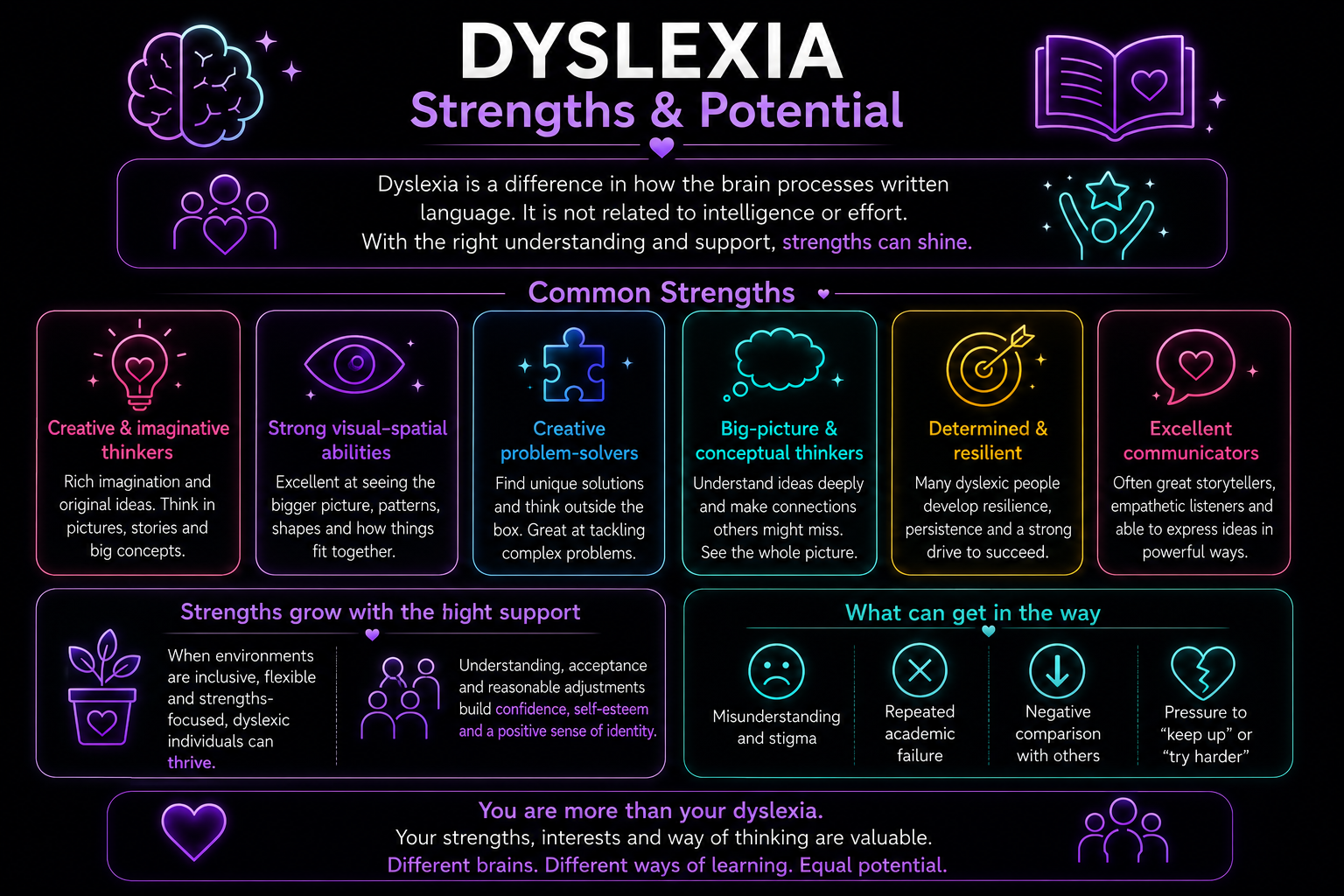
From a neuroaffirmative perspective, dyslexia represents a profile of cognitive strengths and differences rather than a deficit or disorder. Dyslexic individuals often demonstrate strengths in areas such as visual-spatial reasoning, creative thinking, and holistic problem-solving (Eide & Eide, 2011).
Dyslexia typically involves difficulties with phonological processing, the ability to recognise and manipulate the sound structure of language, which underlies challenges with reading fluency and accurate decoding (Shaywitz & Shaywitz, 2005). Associated difficulties may include working memory, processing speed, and written expression. Dyslexia is not related to intelligence, and many dyslexic individuals achieve highly when provided with appropriate support and environmental adjustments.
The degree to which dyslexia affects an individual is shaped significantly by educational context, available accommodations, and social responses to the difference.
A neuroaffirmative note
Dyslexic individuals often develop creative compensatory strategies that reflect cognitive flexibility and resilience. Distress and underachievement are commonly linked to unsupportive environments, inadequate accommodations, and internalised shame, not to dyslexia itself. Practitioner approaches that focus on strengths, reduce shame, and ensure access to appropriate adjustments can significantly improve wellbeing and participation.
Dyslexia — Helpful Resources & Links
British Dyslexia Association
The leading charity for dyslexia in the UK: Information, support, and the BDA Quality Mark scheme for dyslexia-friendly workplaces and schools.
https://www.bdadyslexia.org.uk/
International Dyslexia Association
International non-profit providing research-based information, professional development, and advocacy for individuals with dyslexia.
https://dyslexiaida.org/
Helen Arkell Dyslexia Charity
UK charity offering assessments, tailored tuition, and training for individuals with dyslexia and related learning differences.
https://www.helenarkell.org.uk/
The Dyslexia-SpLD Trust
A collaboration of leading dyslexia and SpLD organisations providing free resources and guidance for practitioners and families.
https://www.thedyslexia-spldtrust.org.uk/
Dyslexia Strengths
Alongside literacy-related differences, research has identified several context-dependent strengths associated with dyslexia, including visual-spatial reasoning, creativity, innovative problem-solving, and big-picture thinking (Armstrong, 2015; Berninger & Wolf, 2016; Maw et al., 2024). Whether these characteristics are experienced as strengths or challenges often depends on the environment, opportunities, and the availability of appropriate support and adjustments. Supportive, person-centred approaches that recognise diverse ways of learning can promote confidence, self-understanding, and participation, whilst helping individuals build on their strengths rather than focusing solely on areas of difficulty (Johnstone & Dallos, 2014; Milton, 2012).
What is Dyscalculia?
Dyscalculia is a neurodevelopmental difference characterised by persistent difficulties with numerical processing and arithmetic, which are inconsistent with the individual's age, cognitive ability, and educational experience (Butterworth, 2019). It is estimated to affect approximately 3–7% of the population and frequently co-occurs with dyslexia, ADHD, and developmental language disorder (Shalev et al., 2001).
From a neuroaffirmative perspective, dyscalculia reflects a different way of processing numerical and quantitative information rather than an inherent deficit. Core difficulties typically involve number sense, an intuitive understanding of quantity and numerical relationships, which underlies challenges with mental arithmetic, number recall, and mathematical reasoning (Butterworth, 2010).
Individuals with dyscalculia may also experience difficulties with time management, financial planning, and spatial reasoning, as these tasks draw on overlapping cognitive processes. Dyscalculia is distinct from mathematics anxiety, though the two frequently co-occur, particularly in individuals who have received little understanding or appropriate support. With the right accommodations and teaching strategies, people with dyscalculia can develop effective approaches to numerical tasks.
Dyscalculia — Helpful Resources & Links
Dyscalculia Network
A UK-based network providing information, resources, and support for individuals with dyscalculia, parents, and educators.
https://www.dyscalculianetwork.com/
About Dyscalculia
Dedicated resource centre with practical information about dyscalculia, including guidance for assessment and support strategies.
https://www.aboutdyscalculia.org/

EdPlace — Dyscalculia Support
Educational platform with resources and worksheets designed to support learners with dyscalculia and maths learning differences.
https://www.edplace.com/blog/what-is-dyscalculia
What is Dysgraphia?
Dysgraphia is a neurodevelopmental difference affecting written expression, specifically, the motor processes involved in handwriting and the linguistic or orthographic processes underlying written composition. The term encompasses two partially overlapping presentations: motor dysgraphia, characterised by difficulties with handwriting legibility, letter formation, and fine motor control; and language-based dysgraphia (sometimes termed dysorthographia), involving difficulties with spelling, written syntax, and compositional fluency that are disproportionate to oral language ability (Berninger et al., 2008).
Dysgraphia frequently co-occurs with dyslexia, dyscalculia, ADHD, and developmental coordination disorder, as these conditions share overlapping cognitive and neurological profiles. In many cases, what presents as poor handwriting or written expression reflects broader executive function difficulties rather than a lack of effort or ability.
From a neuroaffirmative standpoint, dysgraphia represents a difference in the neurological processes supporting written output. The functional impact is highly context-dependent, and appropriate adjustments, such as typing, speech-to-text tools, and extended time, can substantially reduce barriers to participation and allow individuals to demonstrate their knowledge and ideas more fully (CAST, 2018).
Technology as an equaliser
Modern assistive technology: Speech-to-text software, predictive text, grammar checkers, and digital note-taking tools, can significantly reduce the impact of dysgraphia in educational and professional settings. Supporting access to these tools is a low-cost, high-impact adjustment.
1 in 6 adults
adults reading level of an 11-year-old (gov.uk)
10%
population in the UK have dyslexia
References
Berninger, V., & Wolf, B. (2016). Dyslexia, Dysgraphia, OWL LD, and Dyscalculia Lessons from Science and Teaching (2nd ed.). Baltimore, MD: Paul H. Brookes.
British Dyslexia Association (BDA). (2023). Dyslexia Style guide. Retrieved February 14, 2024, from https://cdn.bdadyslexia.org.uk/uploads/documents/Advice/style-guide/BDA-Style-Guide-2023.pdf?v=1680514568
British Dyslexia Association (BDA). (2018). Understanding and supporting neurodiversity: Support strategies for parents and carers. Department for Education. Retrieved October 02, 2023, from https://cdn.bdadyslexia.org.uk/uploads/documents/Advice/Webinar-Training/Support_strategies_for_all_parents_and_carers_250118_copy.pdf?v=1554825979
Cosden, M., Patz, S., & Donahue, M. (2012). Psychosocial problems and psychotherapy for persons with dyslexia. In N. Alexander-Passe (Ed.), Dyslexia and mental health: Investigations from differing perspectives (pp. 19–26). Nova Science Publishers. https://www.researchgate.net/publication/281888797_Psychosocial_problems_and_psychotherapy_for_persons_with_dyslexia
Frith, U. (1999). Paradoxes in the definition of dyslexia. Dyslexia: An International Journal of Research and Practice, 5(4), 192–214. https://doi.org/10.1002/(SICI)1099-0909(199912)5:4<192::AID-DYS144>3.0.CO;2-N
Government UK. (2017, October 2017). Simone: dyslexic user - Statistics about dyslexia. Retrieved April 20, 2024, from https://www.gov.uk/government/publications/understanding-disabilities-and-impairments-user-profiles/simone-dyslexic-user
Ijeoma J-A., & Chinelo, U. (2019). Dyslexia, neurodevelopmental conditions and comorbidity: A rule rather than an exception. Archives in Neurology & Neuroscience, 4(2). https://doi.org/10.33552/ANN.2019.04.000585
Knight, C. (2025). Dyslexia: Identity, labelling and its place in inclusive education. British Journal of Special Education, 52(2), 251–257. https://doi.org/10.1111/1467-8578.70028
Nalavany, B. A., Kennedy, R., Lee, M. H., Carawan, L. W., & Knight, S. M. (2023). Insights from a Web‐based survey into the psychosocial experiences of adults with dyslexia: Findings from a final comment question. Dyslexia: An International Journal of Research and Practice, 29(4), 441–458. https://doi.org/10.1002/dys.1756
Wilmot, A., Pizzey, H., Leitão, S., Hasking, P., & Boyes, M. (2022). Growing up with dyslexia: Child and parent perspectives on school struggles, self‐esteem, and mental health. Dyslexia, 29(1), 40–54. https://doi.org/10.1002/dys.1729
Wilmot, A. , Pizzey, H., Leitão, S., Hasking, P., & Boyes, M. (2023). ‘I struggle at times to see her struggle’: Mothers’ perspectives on dyslexia‐related school struggles and the inter‐connected nature of mother and child well‐being. Dyslexia, 29(2), 136–150. https://doi.org/10.1002/dys.1733
Unless otherwise stated, all original images were created by Nahory HM and AQ (2019). This excludes images, graphics, or other content accessed via external websites, news articles, or signposted resources.