
Tics and Tourette Syndrome
Resources and information about tic disorders and Tourette syndrome.
About Tic Disorders and Tourette Syndrome
Tic disorders are characterised by sudden, repetitive, non-rhythmic movements or vocalisations called tics. Tourette Syndrome (TS) is the most complex form, involving multiple motor tics and at least one vocal tic lasting more than a year.
Tics are involuntary, though some people may feel a premonitory urge before a tic occurs and can sometimes temporarily suppress tics. Tic disorders are more common than many people realise and are frequently associated with other conditions such as ADHD, autism and some mental health challenges such as OCD.
Common misconceptions, particularly about coprolalia (involuntary swearing), mean many people with TS face stigma. In fact, coprolalia affects only a minority of people with Tourette syndrome.
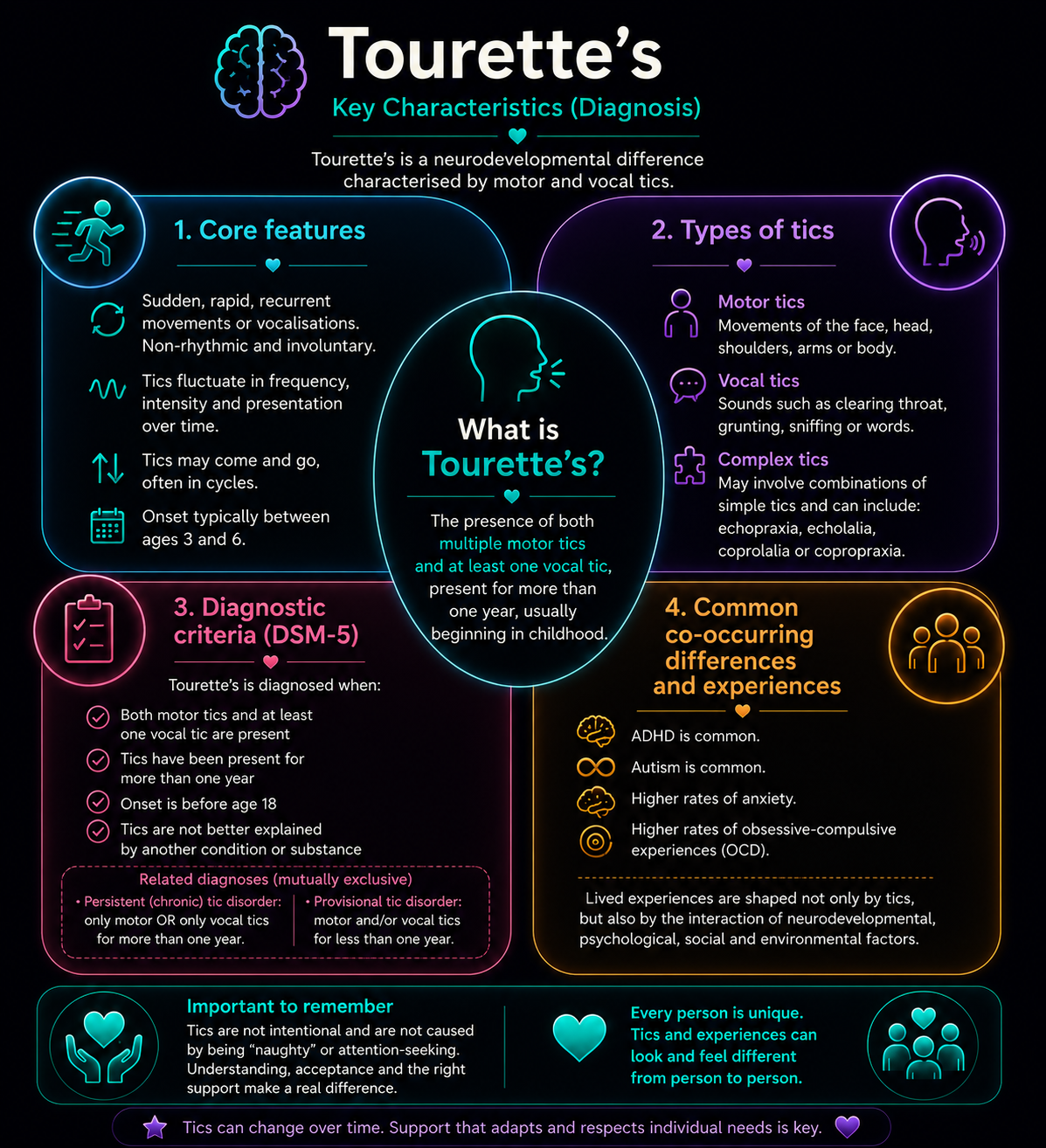
Complex tics may include
Echopraxia: The involuntary imitation of another person’s movements.
Echolalia: The repetition of one’s own or another person’s sounds, words, or phrases.
Coprolalia: The involuntary and repetitive use of words or phrases considered socially inappropriate.
Copropraxia: The involuntary and repetitive enactment of gestures perceived as sexual, obscene, or socially inappropriate (Information from Stern et al. (2005) and Victorio (2025).
Tourette's Strengths
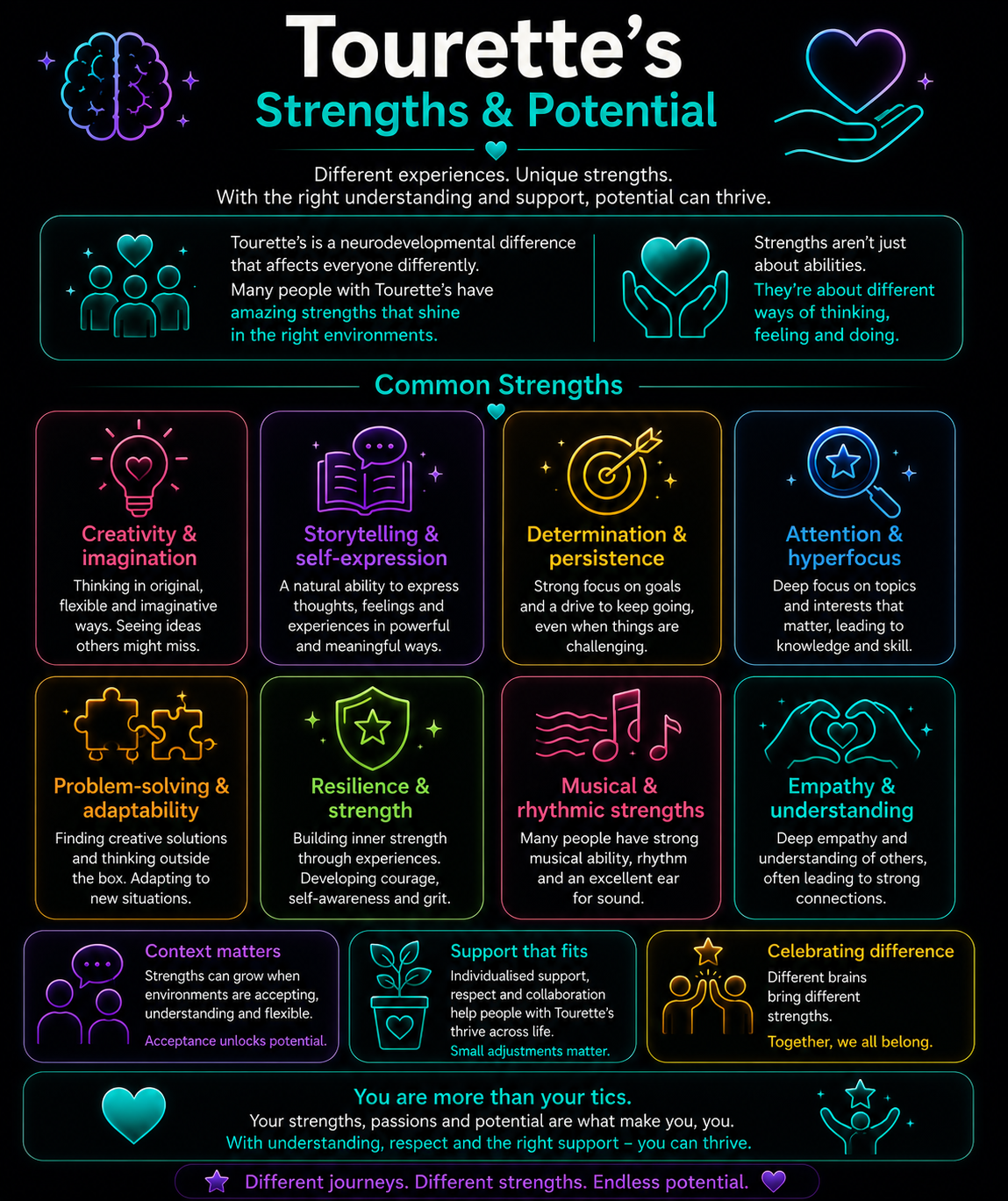
Neurodiversity-affirming perspectives recognise that many challenges associated with Tourette's arise from misunderstanding, stigma, and environments that are not accepting of visible differences, rather than from tics alone (Oliver & Barnes, 2012; Tourette Association of America, 2025).
Research highlights strengths that may be associated with Tourette's, including creativity, determination, persistence, attentional control, and strong engagement with meaningful interests (Colautti et al., 2021). Supportive, accepting environments and person-centred approaches can promote self-understanding, confidence, well-being, and recognition of both strengths and challenges (Milton, 2012; Stern, 2004).
I recommend the second version, as it is brief, easy to read, neurodiversity-affirming, and consistent with the style of your autism, ADHD, and dyspraxia pages.
Key Facts
10%
Organisations and Resources

Tourettes Action
The leading UK charity for people with Tourette syndrome and tic disorders.
https://www.tourettes-action.org.uk/
Great Ormond Street Hospital — Tourette Syndrome
Clinical information and patient resources from GOSH.
https://www.gosh.nhs.uk/conditions-and-treatments/conditions-we-treat/tourette-syndrome/

ACAMH — About Tourette Syndrome
Evidence-based resources for clinicians and families.
https://www.acamh.org/topic/tourette-syndrome/
NIMH — Mental Health Medications
Information about medications used in tic disorder treatment.
https://www.nimh.nih.gov/health/topics/mental-health-medications
Tourettes Action – Our Story
A personal story from the Tourettes Action charity.
Tourette's Is Not What You Think
Challenging common misconceptions about Tourette syndrome.
Dance Artist Claire Sargeant – Tourette's Makes Us Unique
A celebration of neurodivergent identity and creativity.
References
Andrén, P., Jakubovski, E., Murphy, T. L., Woitecki, K., Tarnok, Z., Zimmerman-Brenner, S., van de Griendt, J., Debes, N. M., Viefhaus, P., Robinson, S., Roessner, V., Ganos, C., Szejko, N., Müller-Vahl, K. R., Cath, D., Hartmann, A., & Verdellen, C. (2022). European clinical guidelines for Tourette syndrome and other tic disorders-version 2.0. Part II: psychological interventions. European child & adolescent psychiatry, 31(3), 403–423. https://doi.org/10.1007/s00787-021-01845-z
British Medical Journal (BMJ). (2019). BMJ Best Practice: Patient information from BMJ Tourette's syndrome. Retrieved July 3, 2020, from file:///C:/Users/Student/Downloads/Tourette%E2%80%99s%20syndrome%20(1).pdf
British Medical Journal (2024a, March, 23). BMJ Best Practice: Tic disorders. Retrieved April 20, 2024, from https://bestpractice.bmj.com/topics/en-gb/970
British Medical Journal (2024b, March, 23). BMJ Best Practice: Tourette's syndrome. Retrieved April 20, 2024, from https://bestpractice.bmj.com/topics/en-gb/1042
Burd, L., Li, Q., Kerbeshian, J., Klug, M. G., & Freeman, R. D. (2009). Tourette syndrome and comorbid pervasive developmental disorders. Journal of child neurology, 24(2), 170–175. https://doi.org/10.1177/0883073808322666
Denckla, M. B. (2006). Attention-Deficit Hyperactivity Disorder (ADHD) Comorbidity: A Case for ``Pure’’ Tourette Syndrome? Journal of Child Neurology. 21(8), 701–703. https://doi.org/10.1177/08830738060210080701
Groth C. (2018). Tourette syndrome in a longitudinal perspective. Clinical course of tics and comorbidities, coexisting psychopathologies, phenotypes and predictors. Danish medical journal, 65(4), B5465.
Kerbeshian, J., & Burd, L. (1986). Asperger's syndrome and Tourette syndrome: the case of the pinball wizard. The British journal of psychiatry : the journal of mental science, 148, 731–736. https://doi.org/10.1192/bjp.148.6.731
impact in the UK. Postgraduate medical journal, 81(951), 12–19. https://doi.org/10.1136/pgmj.2004.023614
Tourette Association of America (TAA). (2019, June 26). Introduction to Social Support [Video]. YouTube. https://www.youtube.com/watch?v=kXqa030HLtA
Tourette Association of America (TAA). (2016, April 21). Sensory integration and Tourette syndrome [Video]. YouTube. https://www.youtube.com/watch?v=Z0aAm4FaS1Y
Tourette Association of America (TAA). (2025). Stories that Inspire [Video]. YouTube. https://tourette.org/about-tourette/stories-that-inspire/
Unless otherwise stated, all original images were created by Nahory HM and AQ (2019). This excludes images, graphics, or other content accessed via external websites, news articles, or signposted resources.